Beyond "Copybook" Models: Why Behavioral Economics Must Be Core to Business Education
Book learning just does not cut it anymore
In traditional academic instruction, the study of economics and finance has long depended on theoretical models and archetype postulations. These concepts make up most of the "copybook" information used to explain market mechanics. While these foundational theories provide a necessary baseline, they frequently fail in practice because they assume markets operate strictly through rational equations. In reality, human sentiment in markets represents the crucial missing link in understanding true financial behavior.
The Biological and Psychological Reality of Markets
The formal recognition that economic theory must account for human psychology came when Richard Thaler was awarded the Nobel Prize in Economics. Thaler's work built a vital bridge between the economic and psychological analyses of individual decision-making, cementing the field of behavioral economics.
Every financial choice is made by a human brain—an organ containing approximately 86 billion neurons and 100 trillion synapses working in tandem to compute data, process memories, and rationalize decisions alongside emotional responses. When business curricula focus exclusively on pristine mathematical models, they ignore the biological reality governing market participants.
The Decision Matrix
COPYBOOK ACADEMIC MODEL
- Assumes 100% rational actors
- Relies on static archetype formulas
- Treats market shocks as statistical anomalies
- Focuses solely on numerical metrics and spreadsheet "hacks"
BEHAVIORAL REALITY MODEL
- Driven by 86B neurons and 100T synapses
- Subject to cognitive biases and sentiments
- Recognises fear, greed, & doubt hijack plans
Why Spreadsheet "Hacks" Fail Without Emotional Discipline
In technical environments like trading and corporate finance, market participants quickly discover that quantitative tools are useless if emotional discipline is absent. Unmanaged emotions, specifically doubt hijacking plans, routinely push well-conceived strategies off course. Furthermore, well-documented hijack plans frequently distort decision-making, causing individuals to make irrational choices despite having access to accurate data.
Real-world financial management demonstrates that outcomes depend far more on discipline than on a spreadsheet alone. Financial health is rarely a purely mathematical problem; it is an ongoing management of human anxiety, personal mistakes, and complex trade-offs that cannot be neatly solved inside a spreadsheet cell.
Aligning Academia with Modern CFO Priorities
For university Deans, Department Heads, and faculty, incorporating behavioral insights is not merely an academic exercise—it directly addresses a major talent shortage flagged by corporate executives. In recent surveys, 60% of Chief Financial Officers (CFOs) identified strategic planning and long-term resource allocation as their top priorities. However, when evaluating their own organizations, CFOs report that their biggest roadblocks are demanding workloads and a severe lack of relevant capabilities among finance staff.
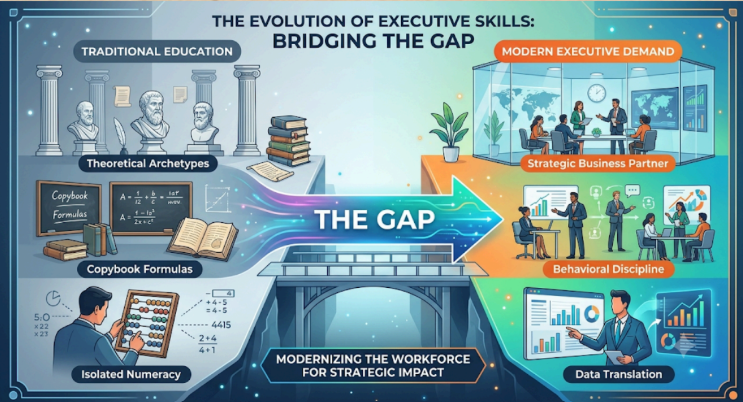
To close this gap, business education must train graduates to perform the true role of a financial professional:
- Serving as a Funnel: A financial analyst is not just a spreadsheet operator, but a funnel between unrefined numbers and business decisions, connecting real-world operations with financial performance.
- Translating Jargon: Success requires turning complex economic concepts into simple, actionable insights. Explaining that a company has "fewer cash resources to pay short-term bills" is far more valuable to executive leadership than simply reciting a falling ratio.
- Fostering "Learning Machines": As highlighted by veteran investors, the most successful professionals in volatile markets are "learning machines" who go to bed every night a little wiser than when they got up. Static degrees must be replaced by a commitment to continuous, curious learning.
The Closing Bell
By integrating behavioral economics alongside quantitative modeling, higher education institutions can transition students from passive learners of theoretical archetypes into resilient, day-one financial leaders. Combining analytical rigor with an understanding of human psychology ensures that graduates possess the exact capabilities modern CFOs say are missing in the market.
Disclaimers
This article is strictly for educational and informational purposes and does not constitute financial, investment, or trading advice. Readers should conduct their own research or consult a qualified professional before making any strategic or financial decisions. This publication operates independently, with no affiliate, revenue-sharing, or promotional links to any regulated entities or brokerages.